
2848
IRS representation · January 2021
Prepare a power of attorney for named individuals to represent you before the IRS on the matters you specify. Review both original pages, including each representative’s declaration, then download the editable PDF for signature and delivery.
Preparing the official PDF. You can start filling below.
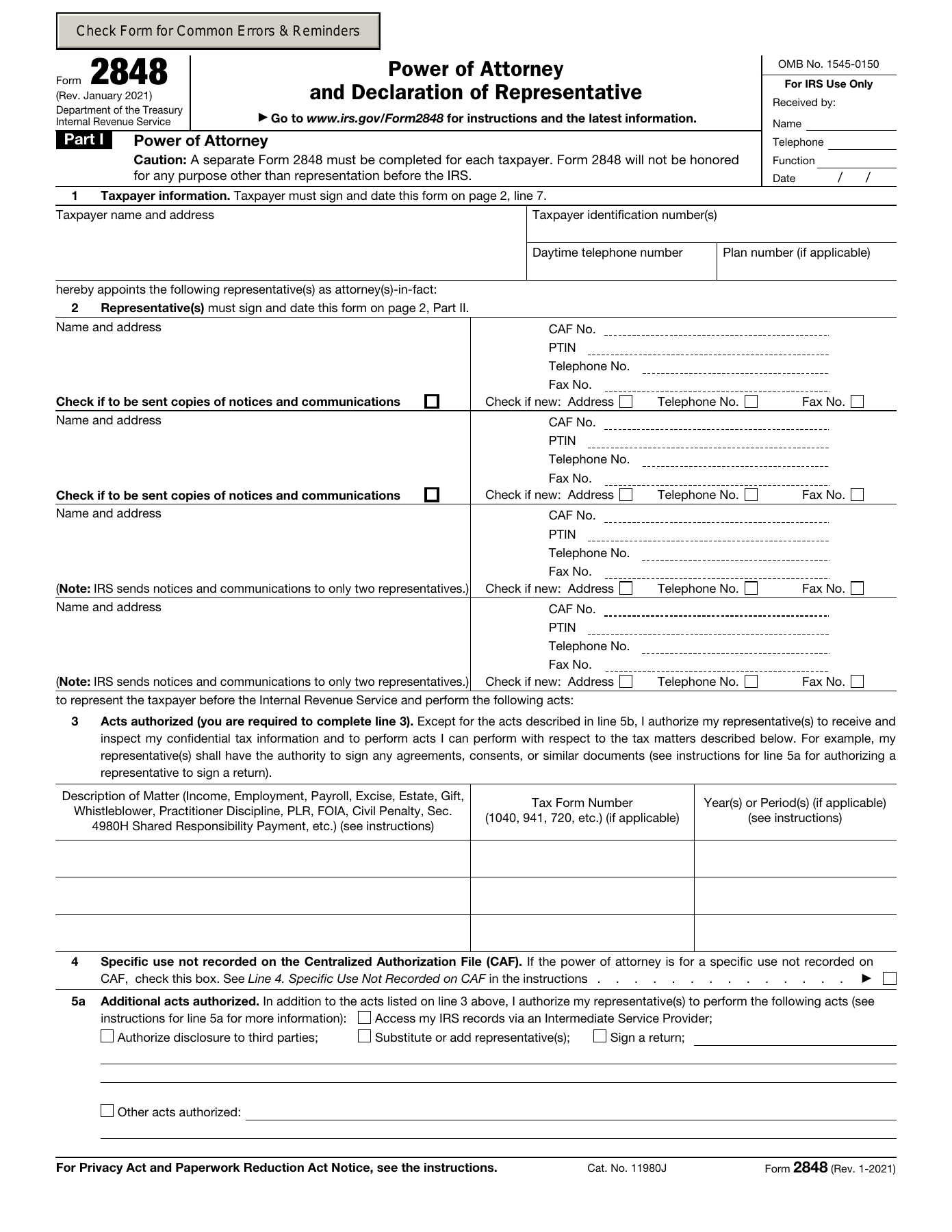
Source: IRS · 2848 · January 2021 · Official blank PDF
What to have ready Have the taxpayer’s full identity and address, each individual representative’s contact and qualification details, specific tax forms and periods, the powers you intend to grant or limit, and copies of earlier powers you want to keep. Spouses need separate forms.
A grant of authority, followed by acceptance.
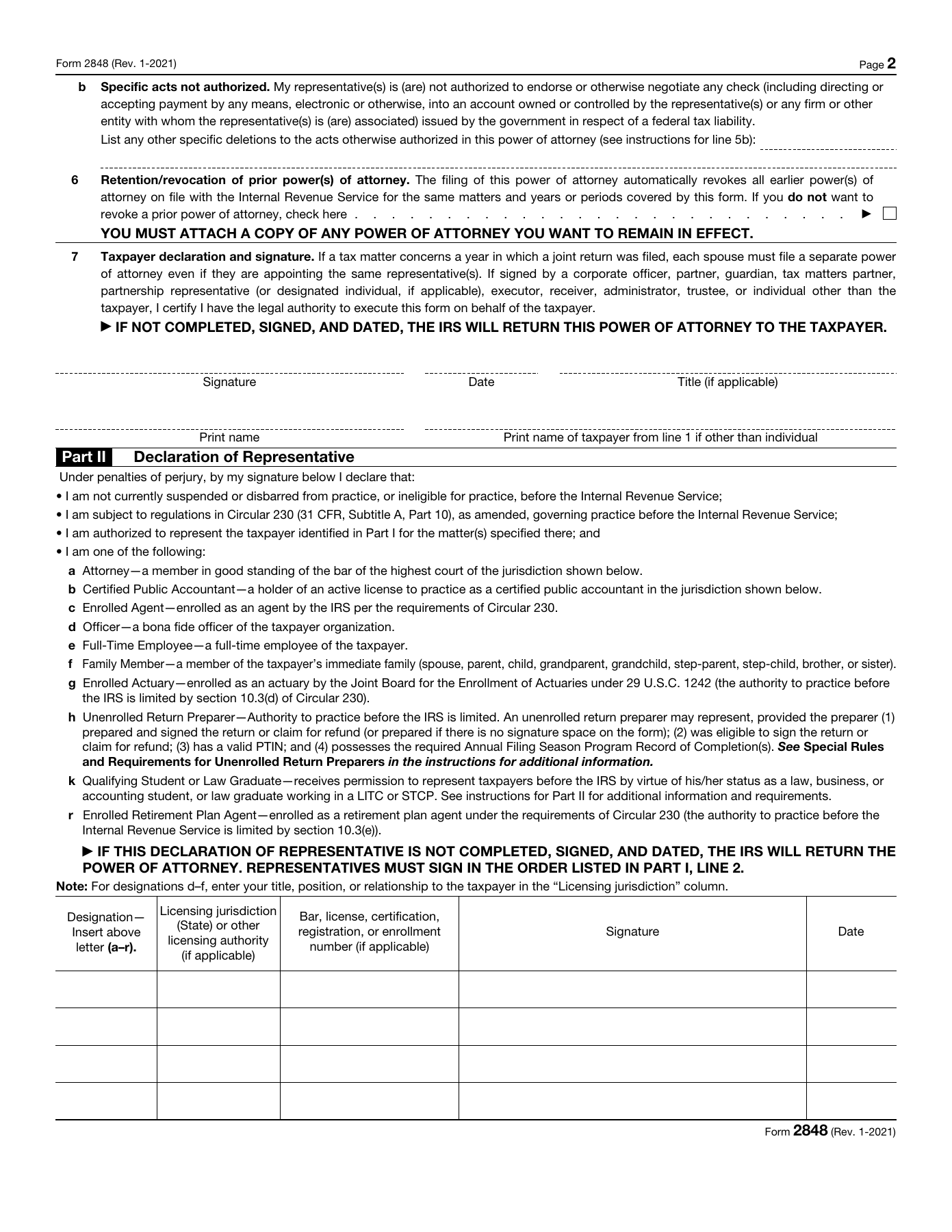
Form 2848 gives eligible people authority to act for the taxpayer. Page 1 defines who and what; page 2 continues the limits and records the taxpayer’s signature and the representatives’ acceptance.
Two pages, two different responsibilities.
- Page 1
Page 1 · Define the representation
The taxpayer names individuals, specifies the tax matters and decides which additional acts are authorized.
 Page 2
 · Limit, sign and accept
Finish restrictions and any retention of earlier powers. The taxpayer signs line 7; each ordinary representative signs Part II in the same order as line 2.

Keep both pages together. The return-signing agent exception below leaves Part II blank; it is not the ordinary representation route.
Locate the four representatives and tax-matter rows on page 1
The letter changes what belongs in Part II.
Choose the actual basis for each individual’s authority. A title, family relationship and professional license are different facts. These examples explain the columns; they do not establish anyone’s eligibility.
aAttorney
A member in good standing of the bar of the highest court of the relevant jurisdiction. Include the applicable state or territory abbreviation.
- Jurisdiction, title or relationship
- Licensing state or territory
- Number, when applicable
- Bar or license number, if any
- Illustrative entry
- a · NY · bar number if assigned
bCertified public accountant
Use the jurisdiction where the CPA holds an active license. A license number is requested if assigned, rather than a universal requirement for every a or b representative.
- Jurisdiction, title or relationship
- Licensing state or territory
- Number, when applicable
- Certification or license number, if any
- Illustrative entry
- b · CA · license number if assigned
cEnrolled agent
An agent enrolled by the IRS under Circular 230. The enrollment card number belongs in the number column; current IRS processing guidance recommends IRS as the authority.
- Jurisdiction, title or relationship
- IRS is recommended
- Number, when applicable
- IRS enrollment card number
- Illustrative entry
- c · IRS · enrollment card number
dOfficer
A bona fide officer of the taxpayer organization. Enter the actual office held, rather than a licensing state.
- Jurisdiction, title or relationship
- Exact officer title
- Number, when applicable
- Not ordinarily applicable
- Illustrative entry
- d · President
eFull-time employee
A full-time employee of this taxpayer. Enter the employee’s title or position; this category does not make an outside consultant an employee.
- Jurisdiction, title or relationship
- Title or position
- Number, when applicable
- Not ordinarily applicable
- Illustrative entry
- e · Comptroller
fFamily member
An immediate family relationship: spouse, parent, child, grandparent, grandchild, step-parent, step-child, brother or sister, including step-brother or step-sister under the instructions.
- Jurisdiction, title or relationship
- Relationship to the taxpayer
- Number, when applicable
- Not ordinarily applicable
- Illustrative entry
- f · Sister
gEnrolled actuary
Enrollment is through the Joint Board for the Enrollment of Actuaries. Representation is limited by Circular 230 section 10.3(d).
- Jurisdiction, title or relationship
- No general state entry required
- Number, when applicable
- Joint Board enrollment card number
- Illustrative entry
- g · Joint Board enrollment number
hUnenrolled return preparer
Limited representation for a return or claim the preparer prepared and signed when required. A valid PTIN is essential; eligibility and any required AFSP records must be checked separately.
- Jurisdiction, title or relationship
- No general state entry required
- Number, when applicable
- Valid PTIN: P followed by eight digits; not applied for
- Illustrative entry
- h · PTIN in both line 2 and Part II
kQualifying student or law graduate
A qualifying LITC or STCP participant with TAS special appearance permission. List the lead attorney or CPA first, then the student, and attach the TAS authorization letter.
- Jurisdiction, title or relationship
- LITC or STCP
- Number, when applicable
- No general license number required
- Illustrative entry
- a or b first · k next · LITC or STCP
rEnrolled retirement plan agent
An IRS-enrolled retirement plan agent. Representation is limited to the scope of Circular 230 section 10.3(e).
- Jurisdiction, title or relationship
- No general state entry required
- Number, when applicable
- IRS enrollment card number
- Illustrative entry
- r · enrollment card number
Designation k has its own clock: the CAF authorization is automatically removed 130 days after the taxpayer signs. An extension requires a new TAS letter and a new Form 2848; changing the old date is not an extension.
Compare Part II columns on original page 2
View the original PDFRepresentation actually taking place outside the United States
The instructions permit a separate exception for an individual representing a taxpayer before IRS personnel outside the United States. Part II is still signed and the jurisdiction column is blank. A foreign mailing address alone does not establish this exception; read the full instructions before selecting that basis.
Read the official form and all instructionsThe limits of designation h
This category does not allow practice before Appeals, revenue officers or Chief Counsel, or signing agreements, waivers and other documents. For returns prepared and signed after December 31, 2015, the required AFSP records cover both the preparation year and representation year. The tax year alone does not establish those facts.
Read the official form and all instructionsWho signs first changes the timing.
Ordinary representatives sign Part II in line 2 order. The 45- or 60-day interval concerns the taxpayer signing first; it is not a deadline for the IRS to receive the form.
Taxpayer signs first · domestic
Taxpayer signsWithin 45 daysRepresentative signsMeasure each representative’s signature date from the taxpayer’s signature date when the taxpayer resides in the United States.
Taxpayer signs first · residing abroad
Taxpayer signsWithin 60 daysRepresentative signsThe longer interval depends on the taxpayer residing abroad, not the representative’s address.
Representative signs first
Representative signsNo 45/60-day limitTaxpayer signsThe taxpayer can sign after a representative without this 45- or 60-day restriction. Representatives still sign in their listed order.
If the signature interval is satisfied, the form can be submitted for processing later. Do not invent a signature date to satisfy a deadline. Complete the actual signatures and applicable dates; typing a printed name here is not signing.
Locate taxpayer signature and printed-name fields on page 2
Choose a delivery channel after signing.
Download both original pages. The taxpayer and each ordinary representative must complete their applicable signatures; this tool does not sign, verify professional eligibility, attach supporting documents or submit the authorization.
Mail or fax requires handwritten signatures; dates may be typed, stamped or handwritten. Online submission may accept electronic signatures under its identity-verification rules. This tool provides neither signature authentication nor automatic submission.
Keep both original pages and add required supporting papers yourself, including retained powers or a TAS letter when applicable. A line 4 specific-use power goes to the office handling the matter. Check the IRS instructions for the appropriate ordinary submission channel.
Special situations and tool limits
Does the taxpayer address update IRS records?
No. The address identifies the taxpayer for this authorization. Prepare Form 8822 or 8822-B separately when changing the IRS address of record.
Read the official form and all instructionsWhat if I only want to revoke a prior power of attorney?
A new Form 2848 appoints representatives. For revocation alone, follow the IRS instructions for marking a copy REVOKE and signing and dating below the notation, or prepare the required signed revocation statement. This editor does not create that separate document.
Read the official form and all instructionsHow are my entries handled?
Your entries are processed in this browser page. Each form keeps its own draft during site navigation; refreshing or closing the page clears the drafts. Optional analytics, including Clarity recordings, follow your choice in Analytics settings and the Privacy Policy. Download a copy to keep your work.
Can I edit the downloaded PDF?
Yes. The exported PDF preserves all 2 original pages and editable fields. It is unsigned. Follow the recipient’s signing and delivery requirements.
Why might some text need review?
The original PDF has limited field space. If text cannot fit or its characters are unsupported by the PDF font, we will identify the field so you can revise it. We never silently remove characters or clip overflowing content.
Check the original and current IRS guidance.
This guide uses Form 2848, revision January 2021, the separate complete instructions and current IRS guidance. The downloadable 2-page original stays in English.
2848 · January 2021
Need information access without representation?
Form 8821 authorizes named recipients to inspect or receive listed tax information. It does not grant representation rights.
Review Form 8821FormAgile is an independent service, not affiliated with the IRS or any government agency. Official blank forms are available free from the IRS. This tool does not provide tax or legal advice.